
- Sector:
- IoT & automation
- Country:
- Italy
Safe unloading: the driver sees the rollover risk before it happens
The problem: rollovers during unloading
When a truck or semi-trailer raises its bed to unload, the center of gravity rises by several meters. A sloped loading area, ground that gives way on one side, or material that compacts and sticks to one side: just a few degrees of roll are enough for the vehicle to go from a state of equilibrium to rolling over—often too quickly for the driver to react.
The project makes visible to drivers, while they unload, what they could previously only guess: how far the vehicle is leaning, how much load is on the cylinder and how close they are to the danger threshold.
A control unit that measures, not estimates
A control unit, developed by one of our partners, is installed in the vehicle and connected to up to four sensor units. Accelerometers and a hydraulic pressure sensor continuously measure the roll angle, pitch angle, tip angle of the dump body, circuit pressure, speed, and estimated load on the cylinder.
The in-cab app: the warning comes before the alarm
The mobile app connects to the control unit via Bluetooth Low Energy and serves as the driver's safety dashboard. An animation shows the cargo bed lifting and changing color as the vehicle approaches the threshold; alerts are also audible, with a silent mode that can be activated in situations where noise is not permitted.
The platform for fleet managers
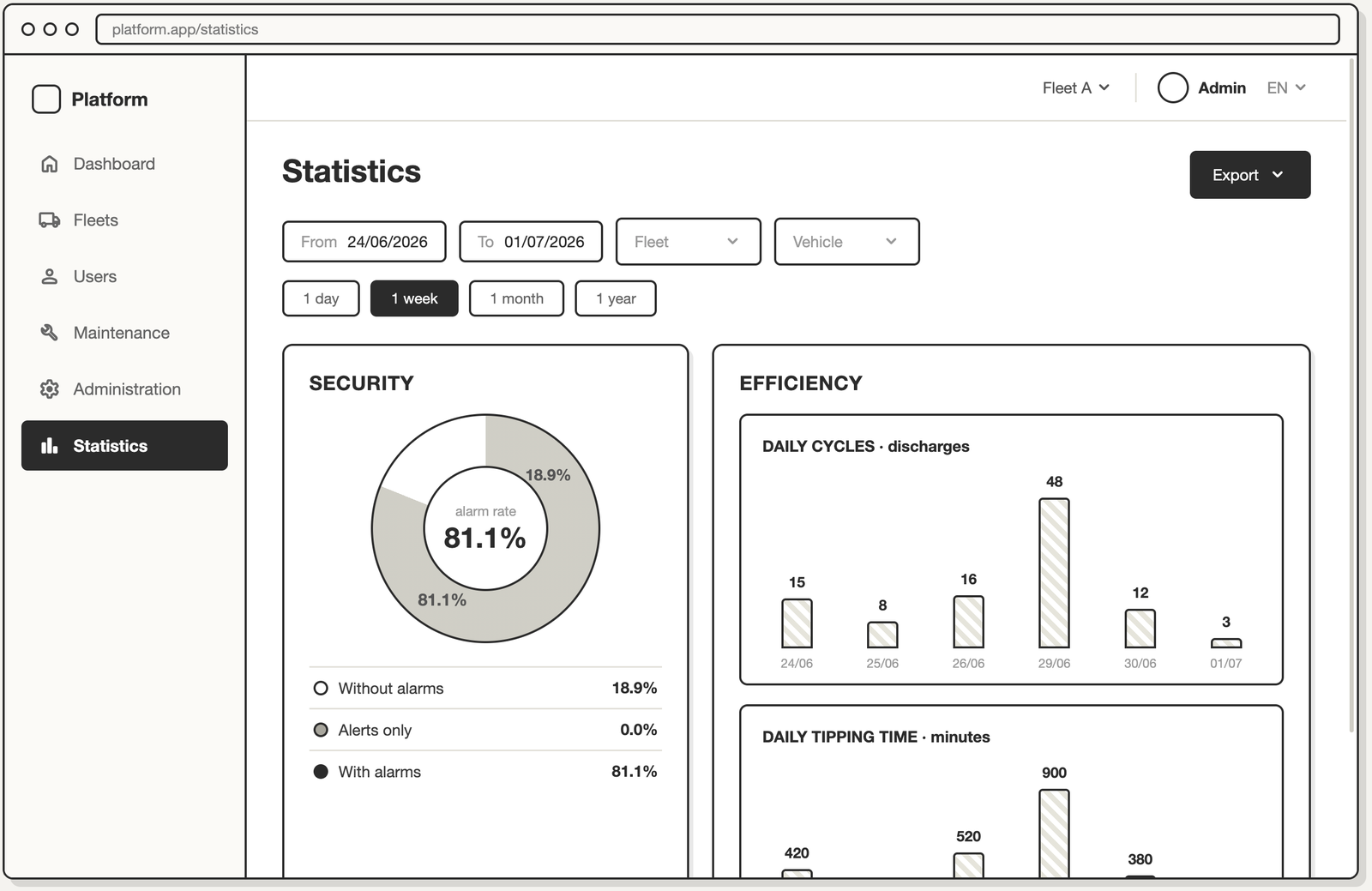
The fleet manager can view cycles and alerts that can be filtered by time period, fleet, vehicle, and driver, along with trend charts, map locations, and the ability to export data to Excel and CSV for external analysis or internal reporting.
The architecture is multi-tenant across multiple levels: the installer sees only the vehicles they install, the company sees only its own fleet, and the fleet manager sees only their own vehicles and drivers. Each user has their own language and time zone, and every sensitive action is logged in a searchable event log.
What this project taught us
Getting sensors, an in-cab app and a cloud platform to talk to each other in real time, where a one-second delay makes all the difference, takes careful choices: reliable Bluetooth on the job site, thresholds that don’t trigger false alarms, data that both drivers and fleet managers can read at a glance. If your vehicles also carry a risk that operators can only guess at today, tell us about it: we start from your problem, not from a ready-made solution.
